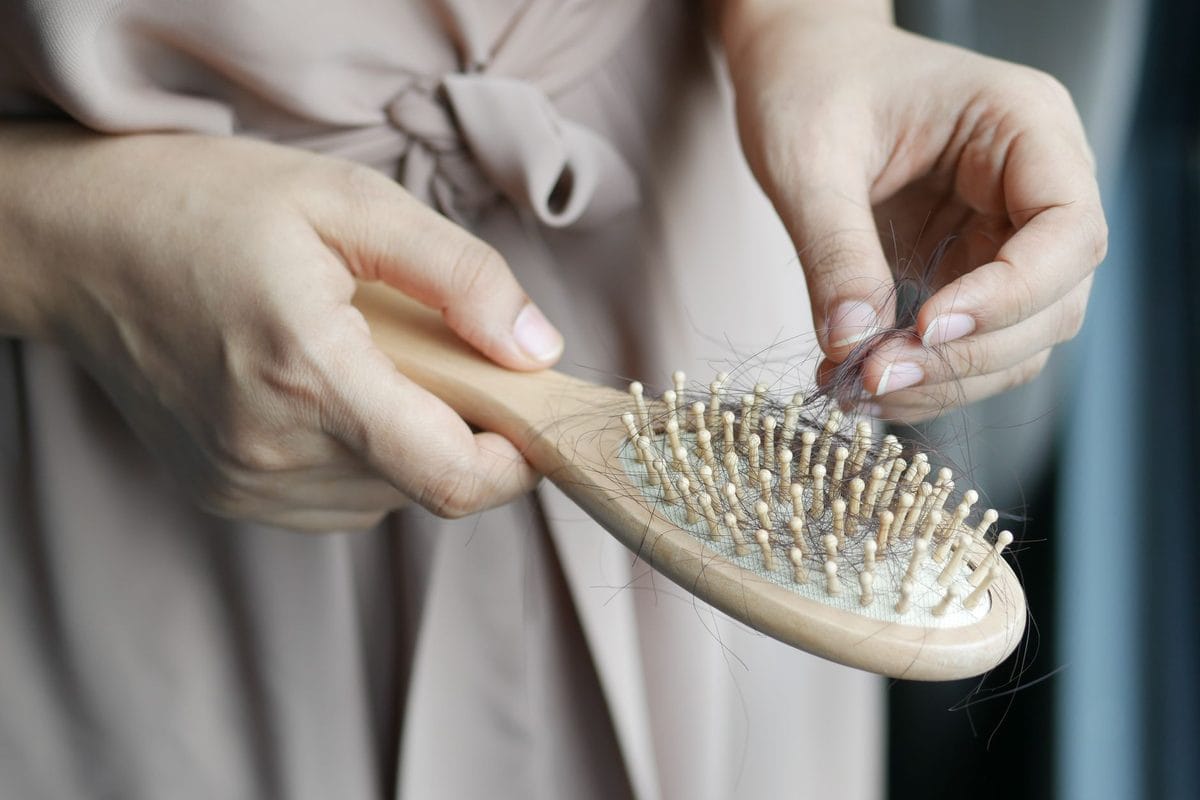
In a study that followed 14 healthy men aged 18 to 39 in Sheffield, England, for 18 months, daily hair loss climbed to about 60 hairs around August and September, more than double the winter figure. That 1991 paper in the British Journal of Dermatology is one of the oldest data points behind something plenty of people notice every year: the brush fills up, the shower drain looks grim, and a sweater pulled over your head comes off with a few extra strands. If that describes your first week of October, you are not imagining it, and it is probably not an emergency. The trouble is that "it's just the season" is also the explanation people lean on for months while something else is going on. The research on seasonal shedding is real, thinner than most beauty articles admit, and still good enough to show you where normal ends and a dermatology appointment begins.
What the Studies Actually Found
Three papers do most of the work, and they do not agree on the exact month. The Sheffield study by Randall and Ebling put the peak of shed hairs in August and September, the point when the fewest follicles were in their growth phase; in that group, the share of follicles in growth peaked above 90% in March and fell steadily to a trough in September. A 1996 study from L'Oréal's research labs followed ten men for 8 to 14 years and found the share of hairs in the resting phase (telogen) peaked at the end of summer and the start of fall. Some people showed two peaks a year, and a few with very low telogen percentages showed no pattern at all. The largest sample came in 2009 from a dermatology team at University Hospital Zürich, which analyzed trichograms, lab counts of hairs in each growth phase, from 823 women who had complained of hair loss, after patients with conditions or medications known to cause it were excluded. Their resting-hair share was highest in summer, with a smaller second peak that appeared in spring and the lowest rates in late winter.
Before you build a theory on that, consider the limits. Two of the three samples were small groups of men, the women in the third were already worried enough to see a specialist, and the newest paper is from 2009. The L'Oréal team also noted that the pattern was not independent of climate, including hours of sunshine, which suggests that where you live may shift the timing. None of the papers explains why hair would shed on a calendar, and anyone selling a confident explanation is guessing. What the data do support is narrower and more useful: some people shed more from late summer into early fall, and shedding rates fall back by late winter. As for how much more, the Sheffield peak of roughly 60 hairs a day sits inside the range the American Academy of Dermatology (AAD) calls normal, which is 50 to 100 hairs daily.
Your Shampoo Is Not the Culprit
Washing your hair does not make more of it fall out.
Cleveland Clinic gives a wider normal range than the AAD, 50 to 150 a day, and notes that thick-haired people can run closer to 150 to 200 simply because they have more follicles. Most of the daily total shows up in the shower, because shampooing and rinsing dislodge strands that were already in their resting phase, as Cleveland Clinic dermatologist Wilma Bergfeld, MD, explains. The drain is a collection point, not a cause. Wash day squeezes several days of ordinary loss into a few minutes, so someone who shampoos twice a week sees three or four days' worth at once, while a daily washer sees it in small installments. Cleveland Clinic makes the same point from the other direction: if you wash less than once or twice a week, expect heavier shedding on wash days because of the buildup. Long hair also exaggerates everything, since a drain full of long strands looks like a crisis even when the count is unremarkable.
Compare this month's drain with last month's, not with a number from the internet. Your own baseline is the only one that matters.
Shedding Versus Thinning
The distinction that matters more than any season is between shedding, where hairs fall out faster than usual and then grow back, and thinning, where follicles gradually produce less hair. For women, the AAD says the first noticeable sign of hair loss is often a widening part or a less full ponytail, and its list of early signs also includes a bald spot that slowly grows and a receding hairline. Female pattern hair loss is the most common cause of hair loss in women; it usually begins in midlife, in the 40s, 50s, or 60s, though it can start earlier, and the AAD says treatment gives the best results when it begins at the first sign. Cleveland Clinic offers a handy contrast: telogen effluvium, the medical term for excessive shedding, means heavy shedding and rapid loss, while pattern loss means slow thinning.
There is a complication. Excessive shedding can occasionally mimic pattern loss, and the AAD notes that some people have both at the same time, so the part in your bathroom mirror is a clue rather than a diagnosis. A dermatologist can tell which one you have, or whether you have both.
The Trigger You May Have Forgotten About
Shedding beyond the seasonal bump has a delay built in, and the delay fools people. The AAD says most people notice excessive shedding a few months after a stressful event; Cleveland Clinic puts it at two to three months. Count backward from today and you land in July or early August. The AAD's list of common triggers includes losing 20 pounds or more, giving birth, a lot of stress (caring for a sick loved one, a divorce, losing a job), a high fever, an operation, recovering from an illness, and stopping birth control pills. Cleveland Clinic adds thyroid conditions, fad diets low in protein, and certain medications to its list.
The reassuring part is that this kind of shedding usually ends. Cleveland Clinic says acute telogen effluvium lasts fewer than six months and goes away in 95% of cases, and the AAD says the excessive shedding stops as the body readjusts. The part nobody enjoys is that you may not connect the fever you had in July to the brush you are cleaning in October.
Book an appointment with a board-certified dermatologist (the AAD runs a Find a Derm search) if any of these sound familiar:
- A bald patch or strip appears within a day or two, or clumps of hair come out when you comb or brush.
- Your part keeps widening or your ponytail keeps getting thinner, month after month.
- Your scalp itches, burns, hurts, or has scaly patches, redness, or sores, which the AAD says can point to an infection, psoriasis, or another condition.
- Eyebrows or eyelashes are thinning too.
- The shedding started a few months after a fever, surgery, major weight loss, or a new medication, and it has not eased.
The visit itself is low-drama. According to the AAD, the dermatologist asks how long you have had the problem and whether it came on quickly, examines your scalp and nails, and gently pulls on your hair to see how it is growing. Blood tests or a scalp biopsy come into play only if a disease, vitamin deficiency, hormone imbalance, or infection is suspected. The AAD adds that the sooner treatment begins, the better the prognosis, which is the strongest argument for not waiting out a problem that is not seasonal.
What Helps and What Wastes Money
Handling your hair
Nothing you do at the sink will cancel a seasonal shed, but gentler habits protect you from breakage, which is a separate problem that gets mistaken for shedding all the time. A quick way to tell them apart is to look at the root end of a fallen hair. A shed hair usually ends in a tiny white bulb of keratin, the club, while a strand that snapped partway down has no bulb at all and points to styling rather than the calendar.
For breakage, the AAD's dermatologist tips are specific. Most people should handle wet hair as little as possible, because wet hair breaks more easily when combed or brushed. The exception: people with tightly curled or textured hair should brush when wet to decrease breakage, so do not copy a straight-haired friend's routine. Use a flat iron only on dry hair, on a low or medium setting, no more often than every other day. And skip wearing braids, cornrows, ponytails, or extensions continuously, since the tension can cause breakage and, if it continues, permanent hair loss.
The supplement aisle
Skip the biotin gummies unless blood work shows you are low. The AAD says you should take biotin, iron, or zinc only when a blood test shows a deficiency, because if your levels are normal, a supplement can be harmful. Too much iron can cause iron poisoning, and its early signs are stomach pain and vomiting. Many hair-loss supplements also pack a large dose of a single nutrient, which is why many dermatologists suggest a multivitamin instead. If your doctor does find a deficiency or low protein intake, they can tell you how to correct it, and that conversation is worth far more than a bottle with a flattering label.
A Two-Minute Monthly Check
Take one photo of your part today, in the same spot and the same light, then repeat it on the first of each month and check your ponytail in the mirror while you are at it. Those two images will tell you more about thinning than any number of drain counts, because pattern loss builds slowly, and the AAD notes people can have it for months or years before they notice. If November's photo looks like today's and the brush calms down by midwinter, you had a seasonal shed. Next time a strand lands on your sleeve, pinch it and check the root for the small white bulb.
Sources: AAD, hair loss vs. hair shedding; AAD, early signs of hair loss; AAD, hair loss diagnosis and treatment; AAD, hair styling without damage; AAD, female pattern hair loss; Cleveland Clinic, telogen effluvium; Cleveland Clinic, hair loss in the shower; Randall and Ebling, Br J Dermatol 1991 (PMID 2003996); Courtois et al., Br J Dermatol 1996 (PMID 8745886); Kunz, Seifert and Trüeb, Dermatology 2009 (PMID 19407435).