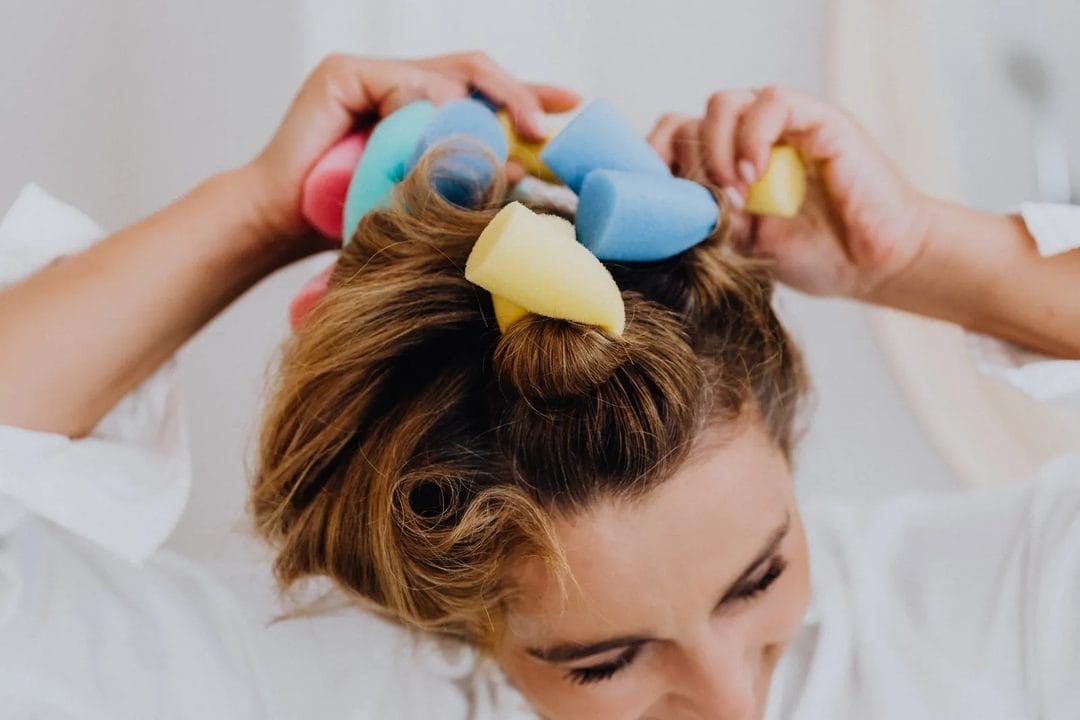
Somewhere between the humidity spike of a July afternoon and the third round-brush blowout of the week, a lot of people quietly gave up on hot tools. Not because a $400 dryer stopped working, but because it kept working exactly as advertised and the curl still fell apart by lunch. The fix that's spreading across salons and bathroom counters this summer isn't a new gadget at all — it's foam rollers, bobby pins, and twist rods, the same tools your grandmother used before blow dryers were a household appliance, and they're holding up to heat and moisture in a way a 450-degree wand simply can't.
Why Heat Is Losing This Particular Fight
Heat styling works by temporarily breaking the hydrogen bonds in hair's protein structure and re-setting them in a new shape. That bond is weak, and it's especially vulnerable to water vapor — which is exactly what summer air is full of. The moment humidity climbs above roughly 60%, hair starts pulling moisture back in and those hydrogen bonds start reverting, which is why a curling-iron set can look perfect at 8 a.m. and be a limp shadow of itself by noon on a muggy day. Heatless setting methods work differently: they rely on tension and drying time rather than a chemical bond reset, so the shape holds even as the hair absorbs ambient moisture, because the curl pattern was built into the hair's dry state rather than forced onto damp hair with heat.
There's also the damage math, which most people underestimate until they see it under a salon microscope. Repeated exposure to tools above 300°F lifts the hair's cuticle and, over months, leads to the frizz and breakage that then gets "fixed" with more heat — a loop stylists have a name for: heat-damage creep. Stylists who track this closely will tell you clients caught in that loop tend to book trims every five or six weeks instead of the usual eight to ten, because the damaged ends split faster than healthy hair does. Foam rollers and flexi rods skip that loop entirely, since there's no cuticle-lifting temperature involved at any point in the process. The trade-off is time: heatless sets typically need six to eight hours to fully dry and hold, which is why nearly everyone doing this now sets their hair before bed rather than in a rushed morning routine. It's a genuine lifestyle shift, not a five-minute swap, and it only sticks for people willing to plan the night before instead of the morning of.
Foam Rollers: the Flattest Learning Curve
Foam rollers are the easiest entry point, and they're inexpensive enough that testing the technique costs less than a single blowout appointment. Kitsch's velvet foam rollers ($14 for a 20-piece set at Ulta) and the classic Conair foam roller set (about $9 at most drugstores) both work on the same principle: damp, not soaking-wet hair, sectioned into pieces roughly one to two inches wide, wound from the ends up toward the scalp, and secured flat against the head. Older Velcro-style rollers grip better on second-day, drier hair but tend to tangle fine strands on the way out, which is exactly why the soft foam versions have mostly replaced them for overnight use. The size of the roller determines the curl — smaller rollers for tighter spirals, larger ones for loose, beachy movement — and mixing sizes across the head is how salon stylists avoid the uniform "just came out of rollers" look. Apply a lightweight mousse or curl cream before rolling (Bounce Curl's Enhancing Foam, around $22, is a common salon pick), since product on dry-set hair does more work than product applied after the fact. Skip the product step and the curl will still form, but it fades faster and looks flatter by the second day, which is the detail most first-time rollers get wrong.
The Part People Get Wrong
Sleeping in rollers sounds uncomfortable, and the first night usually is. But rolling too loosely to avoid discomfort is the single most common mistake — it produces waves that drop within two hours of removal. Roll snugly against the scalp, not just around the hair shaft, and expect one awkward night before your neck adjusts to the shape.
Pin Curls: More Control, More Patience
Pin curls are the technique that made 1940s and '50s hairstyling possible before rollers were widely available, and they remain the best option for anyone who wants precise placement — a deep side part with curls swept off the face, for instance, rather than an all-over set. The method: take a small section, wrap it around two fingers into a flat spiral (a "pin curl" or "barrel curl" depending on direction), flatten it against the scalp, and secure with two crossed bobby pins. Goody's Colour Collection pins (about $5 for 60) are sturdy enough to hold a curl through a full night without slipping, which cheaper flat pins often don't manage.
This is the technique with the steepest learning curve of the three, and it's worth being honest about that rather than pretending it's a five-minute routine. A full head of pin curls takes 25 to 40 minutes the first several times, dropping to under 15 with practice. It rewards patience with a curl that a foam roller genuinely cannot replicate — tighter at the root, looser toward the ends, with the kind of movement that looks like it took a stylist's hands rather than a tool. It is not, however, a technique for a night when you're already exhausted; save it for a Sunday.
Flexi Rods: the Middle Ground
Flexi rods — bendable foam-covered wire, sold in packs of assorted sizes — split the difference between the two. They twist into place rather than rolling flat, which means they sit slightly further from the scalp and are noticeably more comfortable to sleep in than either foam rollers or pin curls. A pack of 18 assorted-size Mia Beauty flexi rods runs about $8, and one pack is usually enough for a full head. Section hair, twist it flat around the rod from root to tip, then bend the ends of the rod to lock it in place — no clips, no pins, no bobby-pin marks to comb out in the morning.
Flexi rods are especially good on medium to coarse hair textures, where foam rollers sometimes struggle to hold enough tension to actually shape the strand. They're a weaker choice on very fine hair, where the rod's slight weight can pull the set looser than a same-size foam roller would. Curly and coily hair types have had the best luck with the smallest rod sizes, using them to define and elongate curl clumps rather than to create curl from straight hair — a use case that's become its own trend inside natural-hair styling communities over the past year.
Setting Up for an Actual Overnight Hold
A cotton pillowcase undoes six hours of careful work in about six minutes.
The friction from rough cotton fibers flattens curls and frizzes the ends long before morning, which is why the pillowcase matters as much as the setting technique itself. A silk or satin pillowcase (Slip's mulberry silk pillowcase runs $89, though a $15 satin one from a drugstore does the same friction-reducing job at a fraction of the price) makes a measurable difference in how much of the set actually survives to daylight. A silk scarf or bonnet tied loosely over the whole set adds another layer of protection and keeps rollers from shifting mid-sleep.
- Start with slightly damp, not wet, hair — fully wet hair takes too long to dry and risks a mildew smell on rollers left in overnight.
- Apply a curl cream or mousse section by section as you go, not all at once beforehand.
- Roll or twist with even tension — too loose and the curl drops, too tight and it can crease.
- Protect the set overnight with silk or satin, and expect at least one uncomfortable night before your sleep position adapts.
- Remove gently in the morning and finger-comb rather than brush; a brush at this stage turns curls into frizz.
Skip step five and the whole set unravels in the worst way — brushing through a fresh heatless curl breaks up the clumped strands that create shape, leaving a fuzzy halo instead of definition. Finger-separate first, and only reach for a wide-tooth comb if a looser, more brushed-out finish is actually the goal rather than defined waves.
Which One Is Actually Worth Your Sunday Night
For a first attempt, foam rollers are the better choice — cheap, forgiving, and fast to learn, even if the curl isn't quite as sculpted as a pin-curl set. Flexi rods are worth the extra $10 or so once your hair reliably holds a set and comfort during sleep matters more than curl precision. Save pin curls for an event that actually calls for shaped, face-framing curls, since the technique takes real practice and isn't worth the time investment on a casual Tuesday.
The appeal isn't really nostalgia, even though the tools themselves are decades old. It's that a set made from tension and dry time doesn't care what the dew point is doing outside, and that's a genuinely useful thing to have in a styling routine once the air turns thick every afternoon from June through September. A curling iron will always be faster for a single morning. Foam rollers, pin curls, and flexi rods are the ones still holding their shape at the end of a humid day out.