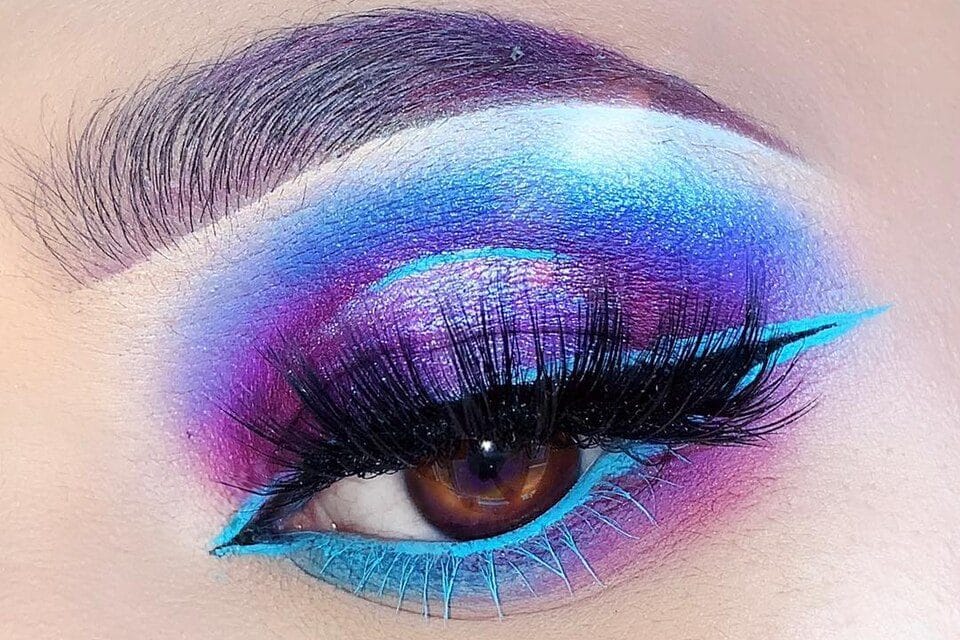
Scroll TikTok for more than ten minutes right now and you'll hit it: a cobalt-blue crease, winged out past the lash line, paired with nothing else on the face but a swipe of blush and clear gloss. The look has been impossible to avoid this year, and the shade doing the heavy lifting almost every time is blue — not the muddy teal that crept back into rotation around 2015, but true, saturated, Pretty in Pink-era blue. It's the kind of color most of us were told to retire somewhere around 2004. It's back, and this time it's not staying in the corner of the lid.
Why Blue Keeps Circling Back
Trend cycles in beauty run roughly twenty years behind fashion, which is exactly why a shade last dominant in the late 1980s is showing up on runways and in Sephora hauls again. Pat McGrath sent full cobalt lids down the runway for several fall shows, and that kind of high-fashion validation tends to trickle into drugstore aisles within a season or two. Add in a wider wave of 80s and 90s nostalgia across fashion — shoulder pads back in department stores, statement denim, claw clips occupying an entire endcap at Target — and blue eyeshadow stops looking dated and starts looking like the obvious next move rather than a costume choice.
What's different this time around is the application, and this is the part worth paying attention to. The original 80s version went all-in: blue from lash line to brow bone, often matched to a blue mascara, with almost no blending between shades. The current version borrows the color but not the technique. Most of the looks getting traction right now use blue as a single, confident statement — often just in the crease or as a thin liner-adjacent wash along the lash line — while the rest of the face stays deliberately quiet. Skin stays even, brows stay soft, and the lip is usually just balm. That contrast, one loud element against an otherwise minimal face, is exactly why it reads as current instead of costume, and it's also the single biggest thing people get wrong on the first attempt.
The Application Trick That Keeps It From Looking Like Halloween
The failure mode almost everyone hits first is treating blue eyeshadow like a neutral transition shade — packing it on solid from lash line to brow bone the way you would a taupe. That's the fastest route to looking like you raided a middle-school production of Grease. Blue reads as costume-y specifically when it's flat and uniform across the whole lid. It reads as intentional when it has depth: a darker navy or cobalt pressed into the outer corner and crease, a lighter cornflower or periwinkle swept through the center of the lid, and bare skin — or a barely-there champagne shimmer — left at the inner corner to keep the whole thing from closing in on itself. Blend the line between the two blues with a clean fluffy brush before you touch liner or mascara. Do that one step and the whole look stops looking flat under camera flash.
Skip winged liner the first few times you try this. It's tempting to go full 80s with a sharp black wing plus a blue lid, but two strong statements on one eye is one too many for daytime, and it's the combination most likely to tip the whole look into fancy-dress territory. A better opening move: apply the blue wet, using a damp flat brush, so the pigment sits closer to the lash line and packs on more like a stain than a powder. Once that feels manageable, add a thin brown or navy liner — never jet black — along the upper lash line only, which sharpens the shape without competing with the color underneath it.
A drugstore eyeshadow primer earns its keep here more than with almost any other shade. Blue pigments, especially the cream and pressed-powder ones, tend to oxidize and dull by midafternoon without a base underneath — e.l.f.'s Poreless Putty Primer, about $10 at Target and Ulta, or NYX's Eyeshadow Primer at roughly $7, both hold color true for a full workday. Skip this step on a payday-fresh cobalt shade and you'll be reapplying by 3 p.m., which defeats the entire point of a statement color.
What to Actually Buy
You don't need a prestige palette to test this out, and dropping $60 on a launch color before you know if it suits you is a bad first move. Start at the drugstore. Wet n Wild's Color Icon single shadows run around $3 at Target and Walmart, and the cobalt and cornflower shades in that line carry real pigment for the price — genuinely one of the better ways to try a bold color before committing further. Maybelline's Color Tattoo cream shadows, about $9 at Target or Ulta, apply straight from a fingertip and hold up through a full workday without creasing into the lid, which loose powder blues often do by hour six.
Once you know which shade family works on you, MAC's single eyeshadow pans — around $24, sold at Ulta and MAC counters — give you the pigment density to build the crease-and-corner technique properly, and e.l.f.'s Bite-Size Eyeshadow palettes, about $10 at Target, pack three or four blue-adjacent shades into one compact, which solves the blending problem in a single purchase. For anyone who wants the liner-only version without committing to a full lid, Urban Decay's 24/7 eyeliner in a cobalt shade, roughly $22 at Sephora and Ulta, tightlines beautifully and smudges into a soft blue wash with nothing more than a fingertip.
Who This Actually Works On
Blue eyeshadow does not care what your eye color is.
Almost every eye color takes blue shadow well — it's one of the few trend colors that genuinely flatters brown, hazel, and green eyes by contrast, not just blue eyes matching blue eyes. The one honest caveat: if you have very warm, golden undertones, a straight cobalt or royal blue can read slightly harsh against the skin on its own, and a teal-leaning or indigo-leaning blue will sit far more naturally against warmer coloring. That's not a reason to skip the trend. It's a reason to shift the shade fifteen degrees toward green or purple before writing off blue altogether.
Glasses change the math too. Blue eyeshadow photographs beautifully but can look muddy behind tinted or blue-light lenses, so anyone who wears glasses daily is better off keeping the color concentrated in the crease rather than the lid, where it will actually be visible instead of getting swallowed by the lens tint.
Building the Rest of the Look
The reason this trend works on camera and in person is restraint everywhere else on the face. A cream blush in a soft peach or berry, a glossy or balm-finish lip, brows left mostly natural rather than heavily filled — that's the whole rest of the routine. Skip contour. Skip a dramatic lash set. The eye carries the entire look, and adding competing texture elsewhere is exactly what pushes a good blue moment into overdone territory.
Hair pulls the retro thread through without needing a single new product: a claw clip worn half-up, a deep side part, or full victory rolls for anyone leaning further into the decade. None of it requires buying anything new — just a few fewer minutes spent on everything else, which is honestly the real reason this trend has stuck around longer than most TikTok makeup moments tend to.